

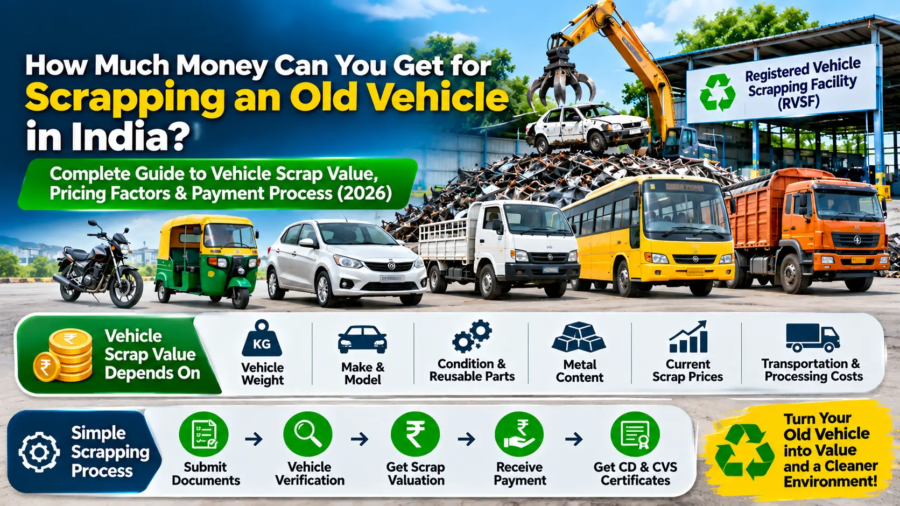
Are you planning to scrap your old vehicle? One of the first questions that comes to mind is: How much money can I get for my old vehicle?
The scrap value of a vehicle depends on several factors, including its weight, model, condition, material composition and current scrap market prices.
Whether your vehicle is a two-wheeler, three-wheeler, car, bus, truck or commercial vehicle, understanding its scrap value can help you make a better decision.
In India, vehicle owners can scrap eligible end-of-life vehicles through a Registered Vehicle Scrapping Facility (RVSF), subject to applicable requirements and the facility’s accepted vehicle categories.
In this guide, we will explain:
- How much money you can get for scrapping an old vehicle.
- Factors that affect your vehicle’s scrap value.
- How vehicle scrap value is calculated.
- Scrap value differences between vehicle categories.
- How to get a fair price for your old vehicle.
- The vehicle scrapping and payment process.
- Important documents required for vehicle scrapping.
1. How Much Money Can You Get for Scrapping an Old Vehicle in India?
The amount you receive for scrapping an old vehicle depends on its weight, materials, condition and current market value.
There is no single fixed scrap price for every vehicle in India.
The final amount is generally determined through the valuation offered by the scrapping facility.
Factors that influence the amount include:
- Vehicle make and model.
- Kerb weight of the vehicle.
- Quantity of recoverable metal.
- Condition of the vehicle.
- Reusable components.
- Current scrap metal market prices.
- Transportation and processing costs.
Important: The Government of India does not prescribe one fixed scrap price for every private vehicle. The price is influenced by market conditions and the vehicle’s valuation.
2. What Factors Affect the Scrap Value of an Old Vehicle?
Several factors determine how much money you can receive for your old vehicle.
A. Weight of the Vehicle
- Vehicle weight is one of the important factors in scrap valuation.
- Heavier vehicles generally contain more recoverable materials.
- The weight of the vehicle can influence its potential scrap value.
B. Vehicle Make and Model
- Different vehicle models have different weights and material compositions.
- Two-wheelers, three-wheelers, cars, buses and trucks have different specifications.
- Larger vehicles may contain more recoverable metal.
C. Metal Content
An old vehicle contains several recyclable materials, such as:
- Iron and steel.
- Aluminium.
- Copper.
- Other recoverable metals.
The market value of these materials can affect the final scrap price.
D. Condition of the Vehicle
- A damaged vehicle may have fewer reusable components.
- A non-running vehicle may require additional handling or transportation.
- Reusable components may contribute to the vehicle’s overall valuation.
E. Current Scrap Metal Prices
- Scrap metal prices change with market conditions.
- Iron, steel, aluminium and copper have different market values.
- Changes in metal prices can affect the amount offered for an old vehicle.
F. Transportation and Processing Costs
- Vehicle pickup may involve transportation expenses.
- Dismantling and depollution require proper facilities.
- Applicable handling and processing costs may influence the final offer.
3. How Is the Scrap Value of a Vehicle Calculated?
The scrap value of a vehicle is generally estimated by considering its recoverable materials and their market value.
A simplified valuation approach includes:
Step 1: Check the Vehicle Weight
- Identify the kerb weight or applicable vehicle weight.
- Vehicle weight depends on its category and specifications.
Step 2: Estimate Recoverable Materials
- Identify recoverable iron and steel.
- Consider aluminium, copper and other materials.
- Account for components that can be reused or recycled.
Step 3: Check Current Market Prices
- Check prevailing scrap metal prices.
- Consider the quality and quantity of recoverable materials.
Step 4: Consider Processing Costs
- Include dismantling and depollution requirements.
- Consider transportation and other applicable costs.
Step 5: Receive the Final Valuation
- The scrapping facility assesses the vehicle.
- The facility provides its offer based on the applicable valuation process.
- The final amount is agreed upon between the vehicle owner and the scrapping facility.
Note: This is a simplified explanation, not a universal government-prescribed formula for every vehicle category.
4. How Does Scrap Value Differ Between Vehicle Categories?
Different categories of vehicles may have different scrap values because of their weight, material composition and condition.
A. Two-Wheelers
Examples:
- Motorcycles.
- Scooters.
- Mopeds.
Important points:
- Generally have lower weight than larger vehicles.
- Contain recyclable metals and other materials.
- Their scrap value depends on the actual weight and condition.
B. Three-Wheelers
Examples:
- Auto-rickshaws.
- Passenger three-wheelers.
- Goods three-wheelers.
Important points:
- Their weight and material composition vary by model.
- Some components may be reusable.
- Their scrap value depends on vehicle condition and recoverable materials.
C. Cars and SUVs
Examples:
- Hatchbacks.
- Sedans.
- SUVs and MUVs.
Important points:
- Contain steel, aluminium, copper and other materials.
- Larger vehicles may contain more recoverable materials.
- Their final value depends on model, weight and condition.
D. Commercial Vehicles
Examples:
- Trucks.
- Buses.
- Pick-up vehicles.
- Light commercial vehicles.
Important points:
- Generally have higher weight than many private vehicles.
- May contain larger quantities of recoverable metal.
- Their scrap value depends on vehicle specifications, condition and material recovery.
Remember: A vehicle’s category alone does not determine its scrap value. Actual weight, material composition, condition and market conditions matter.
5. How Can You Get a Fair Price for Your Old Vehicle?
Before handing over your vehicle for scrapping, follow these simple steps.
- Contact an authorized Registered Vehicle Scrapping Facility (RVSF).
- Share the correct vehicle registration details.
- Provide the vehicle make, model and condition.
- Ask how the scrap valuation is calculated.
- Compare quotations where possible.
- Confirm whether vehicle pickup charges apply.
- Check the payment method and expected payment timeline.
- Obtain the necessary documentation.
Important: Always understand the final offer and applicable deductions before accepting it.
6. Documents Required for Vehicle Scrapping
Prepare the required documents before starting the scrapping process.
Common documents and information include:
- Original Registration Certificate (RC).
- PAN card copy of the vehicle owner.
- Identity proof, where required.
- Address proof of the vehicle owner.
- Cancelled cheque or bank account details.
- Registered owner’s mobile number.
- Email ID.
- Authorization letter, if someone else is submitting the vehicle.
- Required vehicle scrapping application (Form 2).
- Additional documents, where applicable.
Additional checks:
- Verify whether any loan or hypothecation is recorded against the vehicle.
- Check applicable pending dues.
- Ensure that the vehicle ownership details are correct.
- Confirm the requirements with the selected RVSF.
7. Step-by-Step Process to Scrap an Old Vehicle in India
Follow these steps to scrap your old vehicle through an authorized facility.
Step 1: Find an Authorized RVSF
- Locate a Registered Vehicle Scrapping Facility.
- Verify its registration and authorization.
- Confirm whether it accepts your vehicle category.
Step 2: Submit Vehicle Details
- Provide the vehicle registration number.
- Share the make and model.
- Provide the vehicle’s condition and location.
- Submit the required documents.
Step 3: Vehicle Inspection and Verification
- The facility verifies the vehicle details.
- Ownership and registration information are checked.
- The vehicle is assessed for scrapping.
Step 4: Receive the Scrap Valuation
- The facility assesses the vehicle.
- A scrap value is offered.
- Review the payment terms and applicable charges.
Step 5: Accept the Offer and Hand Over the Vehicle
- Confirm the agreed amount.
- Complete the required documentation.
- Hand over the vehicle to the registered facility.
Step 6: Receive Payment
- Payment is made through the prescribed payment method.
- Obtain a payment receipt.
- Keep a record of the transaction.
Step 7: Receive Scrapping Certificates
After completing the prescribed scrapping procedure, obtain the relevant certificates:
- Certificate of Deposit (CD).
- Certificate of Vehicle Scrapping (CVS).
Keep these certificates safely for future reference and applicable benefits.
8. What Is the Difference Between Scrap Value and Certificate of Deposit Benefits?
Many vehicle owners confuse the money received for scrapping a vehicle with the benefits available through a Certificate of Deposit.
These are two different things.
A. Scrap Value
- It is the agreed amount paid for the old vehicle.
- It depends on the vehicle’s valuation.
- It is paid to the vehicle owner through the prescribed payment method.
B. Certificate of Deposit (CD)
- It is issued by an authorized Registered Vehicle Scrapping Facility.
- It confirms the deposit and transfer of the vehicle for further treatment.
- It may be used to claim applicable incentives when purchasing another vehicle.
C. Additional Benefits
Under the central framework:
- Motor vehicle tax concessions of up to 25% may be available for non-transport vehicles.
- Concessions of up to 15% may be available for transport vehicles.
- Registration certificate issuance fees may be waived in applicable cases.
The actual benefits depend on applicable government notifications and State or UT implementation.
Important: These incentives are separate from the cash scrap value of your old vehicle.
9. Why Should You Choose an Authorized Vehicle Scrapping Facility?
Choosing an authorized facility helps ensure that the vehicle is scrapped through the prescribed process.
Important benefits include:
- Proper vehicle verification.
- Documented scrapping procedures.
- Environmentally responsible dismantling.
- Safe handling of hazardous materials.
- Proper disposal and recycling of vehicle components.
- Issuance of relevant scrapping certificates.
- Better documentation of the transaction.
Avoid handing over your vehicle to an unauthorized scrap dealer without checking the required legal and documentation procedures.
10. Common Mistakes to Avoid While Scrapping an Old Vehicle
Avoid these mistakes when scrapping your vehicle.
- Choosing a facility without verifying its authorization.
- Accepting an offer without understanding the valuation.
- Ignoring transportation and processing charges.
- Providing incorrect vehicle information.
- Forgetting to check pending loans or hypothecation.
- Not obtaining payment proof.
- Not collecting the scrapping certificates.
- Failing to follow up on the vehicle registration cancellation process.
11. Frequently Asked Questions (FAQs)
Q1. How much money can I get for scrapping my old vehicle in India?
The amount depends on the vehicle’s weight, material composition, condition and prevailing scrap market prices. Contact an authorized RVSF for a vehicle-specific quotation.
Q2. Is there a fixed scrap price for old vehicles in India?
No. There is no single government-fixed scrap price for all private vehicles. The price is determined by market conditions and the condition of the vehicle.
Q3. Does a heavier vehicle get more scrap value?
Generally, a heavier vehicle may contain more recoverable materials. However, its final value also depends on material composition, condition and processing costs.
Q4. Can I scrap an accident-damaged vehicle?
Yes, an accident-damaged vehicle may be accepted for scrapping, subject to ownership verification and applicable requirements.
Q5. Can I scrap a non-running vehicle?
A non-running vehicle may be accepted by an RVSF. Ask the facility about inspection, transportation and pickup arrangements.
Q6. How do I receive payment for my scrapped vehicle?
The registered scrapper pays the agreed consideration through digital payment or an account-payee cheque, as prescribed under the applicable rules.
Q7. What is a Certificate of Deposit?
A Certificate of Deposit is issued by a Registered Vehicle Scrapping Facility to recognize the transfer of the vehicle to the registered scrapper for further treatment.
Q8. Do I receive a certificate after scrapping my vehicle?
Yes. The registered facility issues the Certificate of Vehicle Scrapping after completing the prescribed scrapping and treatment process.
Q9. Can I get benefits when purchasing a new vehicle after scrapping my old vehicle?
Eligible vehicle owners may receive applicable incentives against a Certificate of Deposit, subject to the relevant government notifications and conditions.
12. Conclusion
Scrapping an old vehicle can be a practical option when it is damaged, unfit for use or no longer economical to maintain.
However, the amount you receive depends on several factors, including vehicle weight, material composition, condition and current market prices.
Before scrapping your vehicle:
- Understand how the scrap value is calculated.
- Compare available quotations.
- Check the authorization of the scrapping facility.
- Prepare the required documents.
- Obtain payment proof and scrapping certificates.
Choosing an authorized Registered Vehicle Scrapping Facility helps ensure a documented and environmentally responsible vehicle scrapping process.
Planning to scrap your old vehicle?
Contact MotoScrapland to enquire about vehicle scrapping services, pickup availability and the valuation process.
Make a responsible choice and contribute to a cleaner and more sustainable future through vehicle recycling.
Add a Comment