

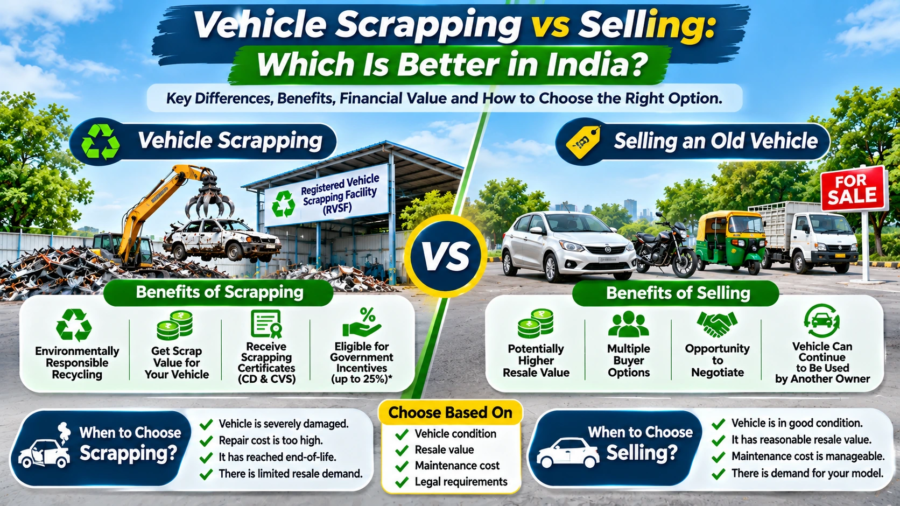
Are you planning to dispose of your old vehicle? Are you confused between selling it and scrapping it?
Both options can help you get money for your old vehicle. However, the better choice depends on the vehicle’s condition, resale value, maintenance costs and current market demand.
Selling an old vehicle may be a better option if it is in good condition and has a reasonable resale value. On the other hand, scrapping may be more suitable when the vehicle is severely damaged, unfit for use or no longer economical to maintain.
In India, vehicle owners can choose to sell eligible vehicles through the used-vehicle market or scrap eligible end-of-life vehicles through a Registered Vehicle Scrapping Facility (RVSF).
In this guide, we will explain:
- What is vehicle scrapping?
- What is selling an old vehicle?
- Key differences between scrapping and selling.
- Financial comparison of both options.
- Benefits of vehicle scrapping.
- Benefits of selling an old vehicle.
- When should you choose scrapping or selling?
- Documents and procedures for both options.
1. What Is Vehicle Scrapping?
Vehicle scrapping is the process of retiring an old, damaged, unfit or end-of-life vehicle and processing it for recycling.
In India, vehicle owners can use a Registered Vehicle Scrapping Facility (RVSF) to scrap eligible vehicles through the prescribed process.
During the vehicle scrapping process:
- The vehicle is inspected and verified.
- Required documents are checked.
- Hazardous materials are removed.
- Reusable components are separated.
- Recoverable materials are sent for recycling.
- The relevant scrapping certificates are issued.
Important benefits of vehicle scrapping:
- Helps remove unfit and end-of-life vehicles.
- Supports responsible vehicle recycling.
- Helps recover valuable materials.
- Reduces improper disposal of vehicle components.
- Provides documented proof of the scrapping process.
2. What Is Selling an Old Vehicle?
Selling an old vehicle means transferring its ownership to another person or an authorized used-vehicle dealer in exchange for an agreed amount.
The vehicle may be purchased for personal use, commercial use, repairs or resale.
Common ways to sell an old vehicle include:
- Selling directly to another individual.
- Selling through a used-vehicle dealer.
- Using an online vehicle marketplace.
- Selling through an authorized vehicle dealer.
Important points to consider:
- The vehicle’s condition affects its resale value.
- Vehicle age and mileage may influence the selling price.
- Maintenance and repair history can affect buyer interest.
- Market demand plays an important role.
- Ownership transfer must be completed through the prescribed procedure.
3. Vehicle Scrapping vs Selling: Key Differences
Both options have different purposes and processes.
Here is a simple comparison:
| Comparison | Vehicle Scrapping | Selling an Old Vehicle |
|---|---|---|
| Main purpose | Recycling and disposal | Transfer of ownership |
| Vehicle condition | Suitable for eligible end-of-life vehicles | Usually suitable for vehicles with resale demand |
| Buyer | Registered scrapping facility | Individual or used-vehicle dealer |
| Payment | Agreed scrap consideration | Agreed selling price |
| Vehicle reuse | Processed for recycling and recovery | May be used by another owner |
| Documentation | Scrapping documents and certificates | Ownership transfer documents |
| Vehicle recycling | Yes, through the prescribed process | Not necessarily |
| Certificate | CD and CVS, as applicable | Updated ownership records |
| Best suited for | Unfit or end-of-life vehicles | Vehicles with reasonable resale value |
Remember: Scrapping and selling are two different options. The right choice depends on your vehicle’s condition and financial value.
4. Financial Comparison: Scrapping vs Selling
One of the most important factors is the amount of money you can receive.
However, there is no fixed amount for either option.
A. Financial Benefits of Vehicle Scrapping
- You receive an agreed amount based on the vehicle’s valuation.
- The scrap value depends on weight and recoverable materials.
- Current scrap metal prices may affect the final amount.
- Vehicle condition and processing costs may influence the offer.
- Eligible owners may receive applicable incentives against a Certificate of Deposit.
B. Financial Benefits of Selling an Old Vehicle
- A vehicle in good condition may have a reasonable resale value.
- Popular models may attract more buyers.
- A complete service history may improve buyer confidence.
- Low mileage may increase buyer interest.
- You may receive a higher amount if the vehicle has strong market demand.
C. Which Option Provides More Money?
The answer depends on the vehicle.
Consider these situations:
Situation 1: Vehicle in Good Condition
- The vehicle runs properly.
- Maintenance costs are manageable.
- The vehicle has reasonable resale demand.
In this situation, selling may provide a better financial return.
Situation 2: Severely Damaged Vehicle
- The vehicle has major accident damage.
- Repairs are expensive.
- There is limited demand for the vehicle.
In this situation, scrapping may be a more practical option.
Situation 3: Old Vehicle with High Maintenance Costs
- Frequent repairs are required.
- Spare parts are difficult to find.
- The vehicle is becoming uneconomical to maintain.
Compare the available resale offer with the scrap valuation before making a decision.
5. Benefits of Vehicle Scrapping
Scrapping an old vehicle offers several financial and environmental benefits.
A. Environmentally Responsible Recycling
- Helps recover reusable materials.
- Supports the recycling of steel, aluminium and copper.
- Encourages proper disposal of vehicle waste.
- Helps reduce improper handling of hazardous components.
B. Proper Documentation
- The scrapping process is documented.
- The registered facility issues the relevant certificates.
- Vehicle owners receive proof of the scrapping process.
C. Applicable Government Incentives
Under the central framework, eligible vehicle owners may receive:
- Motor vehicle tax concessions of up to 25% for non-transport vehicles.
- Motor vehicle tax concessions of up to 15% for transport vehicles.
- Waiver of applicable registration certificate issuance fees when a new vehicle is registered against a valid Certificate of Deposit.
The actual benefits depend on applicable government notifications, eligibility and State or UT implementation.
D. Suitable for End-of-Life Vehicles
- Useful for severely damaged vehicles.
- Suitable for eligible vehicles that are no longer fit for use.
- Helps ensure that end-of-life vehicles are processed through an authorized facility.
6. Benefits of Selling an Old Vehicle
Selling an old vehicle can also be a good option.
A. Potentially Higher Financial Return
- A well-maintained vehicle may have a better resale value.
- Popular models may attract more buyers.
- Vehicles with good service records may receive better offers.
B. Continued Vehicle Usage
- The vehicle can continue to serve another owner.
- A buyer may use it for personal or commercial purposes.
- Usable vehicles can remain in service if they meet applicable requirements.
C. More Selling Options
- You can approach individual buyers.
- You can contact used-vehicle dealers.
- You can explore online vehicle marketplaces.
- You can compare multiple selling offers.
D. Opportunity to Negotiate
- You can compare different buyer quotations.
- You can negotiate based on vehicle condition.
- You can consider the buyer’s offer before finalizing the sale.
Important: Always complete the official ownership transfer. Do not rely only on handing over the vehicle and receiving payment.
7. When Should You Choose Vehicle Scrapping?
Vehicle scrapping may be a better option in the following situations:
- Your vehicle is severely damaged in an accident.
- Repair costs are higher than its practical value.
- Your vehicle is no longer economical to maintain.
- The vehicle has reached the end of its useful life.
- The vehicle is declared unfit under applicable requirements.
- There is very limited resale demand.
- You want to dispose of an eligible end-of-life vehicle through an authorized facility.
Recommendation: Obtain a scrap valuation and verify the applicable scrapping requirements before making your decision.
8. When Should You Choose Selling an Old Vehicle?
Selling may be a better option in the following situations:
- Your vehicle is in good running condition.
- It has a reasonable resale value.
- Maintenance costs are manageable.
- The vehicle has a good service history.
- There is demand for your vehicle model.
- You receive a reasonable offer from a buyer.
- The vehicle can legally continue to be used on public roads.
Recommendation: Compare offers from different buyers and complete the ownership transfer through the prescribed process.
9. Documents Required for Vehicle Scrapping and Selling
The documents required depend on the transaction and applicable requirements.
A. Documents for Vehicle Scrapping
Common documents and information include:
- Original Registration Certificate (RC).
- Identity proof of the vehicle owner.
- Address proof, where required.
- PAN card or applicable financial identification.
- Vehicle owner’s registered mobile number.
- Email ID.
- Authorization letter, if someone else submits the vehicle.
- Required vehicle scrapping application (Form 2).
- Additional documents, where applicable.
B. Documents for Selling an Old Vehicle
Common documents include:
- Original Registration Certificate (RC).
- Form 29.
- Form 30.
- Valid vehicle insurance details.
- Pollution Under Control (PUC) certificate, where applicable.
- PAN card or Form 60, where required.
- Address and identity proof.
- Loan clearance or NOC, if applicable.
- Additional documents required by the registering authority.
Important: Confirm the latest document requirements with the relevant RTO or authorized facility.
10. Step-by-Step Process: Scrapping vs Selling
Both processes involve different steps.
A. Vehicle Scrapping Process
Step 1: Find an Authorized RVSF
- Locate a Registered Vehicle Scrapping Facility.
- Verify its authorization.
- Confirm whether it accepts your vehicle category.
Step 2: Submit Vehicle Details
- Provide the registration number.
- Share the vehicle make and model.
- Provide vehicle condition and location.
- Submit the required documents.
Step 3: Vehicle Verification
- The facility verifies the vehicle details.
- Ownership and registration information are checked.
- Applicable scrapping requirements are confirmed.
Step 4: Receive the Scrap Valuation
- The facility assesses the vehicle.
- A scrap value is offered.
- Review the payment terms.
Step 5: Accept the Offer and Hand Over the Vehicle
- Confirm the agreed amount.
- Complete the required documentation.
- Hand over the vehicle to the registered facility.
Step 6: Receive Payment and Certificates
- Receive the agreed payment.
- Obtain payment proof.
- Collect the relevant Certificate of Deposit and Certificate of Vehicle Scrapping at their respective stages.
B. Old Vehicle Selling Process
Step 1: Evaluate Your Vehicle
- Check the vehicle’s condition.
- Review its maintenance history.
- Check its market resale value.
Step 2: Find Potential Buyers
- Contact individual buyers.
- Approach used-vehicle dealers.
- Explore online vehicle marketplaces.
Step 3: Compare Offers
- Obtain quotations from different buyers.
- Compare the offered amounts.
- Negotiate the final selling price.
Step 4: Complete Documentation
- Prepare the required documents.
- Complete Form 29 and Form 30.
- Follow the applicable ownership transfer process.
Step 5: Receive Payment
- Agree on the payment terms.
- Receive payment.
- Keep proof of the transaction.
Step 6: Confirm Ownership Transfer
- Follow up on the ownership transfer with the registering authority.
- Keep a copy of the submitted documents.
- Verify that the registration records are updated.
11. Common Mistakes to Avoid
Avoid these mistakes when scrapping or selling your old vehicle.
Mistakes While Scrapping
- Choosing an unauthorized scrapping facility.
- Accepting an offer without understanding the valuation.
- Ignoring applicable transportation charges.
- Not checking the required documents.
- Not obtaining payment proof.
- Not collecting the relevant scrapping certificates.
Mistakes While Selling
- Selling without verifying the buyer.
- Handing over the vehicle without proper documentation.
- Not completing the ownership transfer.
- Ignoring pending loans or hypothecation.
- Not keeping payment proof.
- Failing to notify the registering authority of the transfer as required.
12. Frequently Asked Questions (FAQs)
Q1. Is scrapping better than selling an old vehicle?
It depends on the vehicle’s condition and market value. Selling may be better for a vehicle with good resale demand, while scrapping may be more suitable for an eligible end-of-life or severely damaged vehicle.
Q2. Can I get more money by selling my old vehicle?
You may receive more money by selling if the vehicle is in good condition and has strong resale demand. However, the final amount depends on the buyer’s offer and market conditions.
Q3. Is there a fixed scrap price for vehicles in India?
No. The Government does not determine a single fixed scrap price for private vehicles. The price is influenced by market conditions and the condition of the vehicle.
Q4. Can I sell an old or damaged vehicle?
You may sell a vehicle subject to applicable registration, fitness and other legal requirements. Severely damaged or end-of-life vehicles may be more suitable for scrapping.
Q5. What is a Registered Vehicle Scrapping Facility (RVSF)?
An RVSF is a registered facility authorized to receive, dismantle and scrap eligible end-of-life vehicles through the prescribed process.
Q6. What is a Certificate of Deposit?
A Certificate of Deposit is issued by an RVSF to recognize the transfer of the vehicle to the registered scrapper for further treatment. It may be used for applicable incentives when purchasing another vehicle.
Q7. Do I get money after scrapping my old vehicle?
Yes. The owner receives the agreed consideration for the vehicle through the prescribed payment method.
Q8. What happens if I sell my vehicle without transferring ownership?
The registration records may continue to show you as the registered owner until the transfer is completed. Therefore, complete the prescribed ownership transfer and retain proof of the transaction.
Q9. Can I get tax benefits after scrapping my old vehicle?
Eligible owners may receive applicable motor vehicle tax concessions and registration fee benefits against a valid Certificate of Deposit, subject to government notifications and State or UT implementation.
Q10. How do I decide whether to sell or scrap my vehicle?
Compare the resale offer, scrap valuation, repair costs, vehicle condition and applicable legal requirements before making your decision.
13. Conclusion
Choosing between vehicle scrapping and selling depends on your vehicle’s condition, resale value and future usability.
Both options have different financial and practical benefits.
Choose selling when:
- Your vehicle is in good condition.
- It has reasonable resale demand.
- You receive a satisfactory selling offer.
- It can legally continue to be used.
Choose scrapping when:
- Your vehicle is severely damaged or unfit.
- Repair costs are too high.
- It has reached the end of its useful life.
- It is eligible for scrapping through an authorized facility.
Before making your decision, compare both options and understand the applicable documentation and legal requirements.
Planning to scrap your old vehicle?
Contact MotoScrapland to enquire about vehicle scrapping services, pickup availability and the valuation process.
Choose a responsible vehicle disposal option and contribute to a cleaner and more sustainable future through vehicle recycling.
Add a Comment