

Introduction
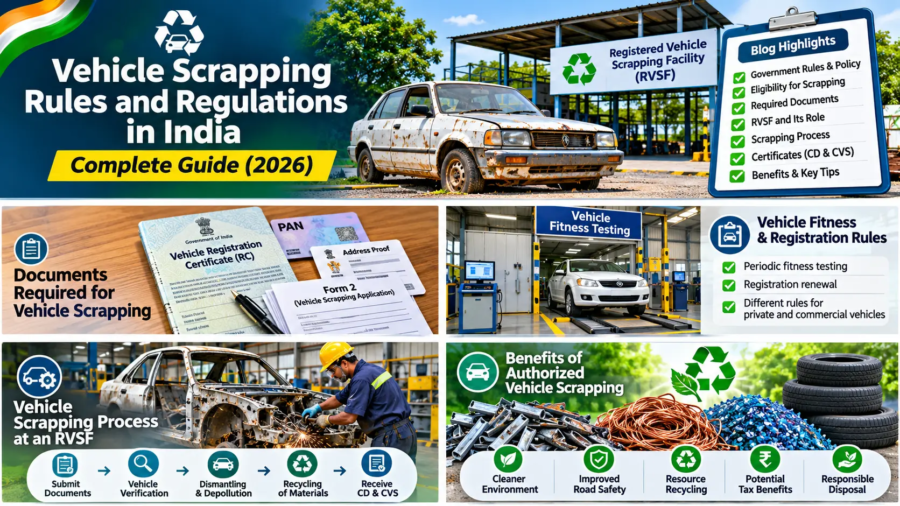
Vehicle scrapping is an important step towards reducing vehicle pollution, improving road safety and promoting responsible recycling in India.
The Government of India has introduced the Vehicle Scrapping Policy to encourage the removal of old, unfit and polluting vehicles through an organized scrapping system.
However, vehicle scrapping in India is not simply about selling an old car to a scrap dealer. Vehicle owners should understand the applicable rules, registration requirements, documentation and procedures before scrapping their vehicles.
In this guide, we will explain:
- Vehicle scrapping rules and regulations in India.
- Government Vehicle Scrapping Policy.
- Rules related to old and unfit vehicles.
- Documents required for vehicle scrapping.
- Role of Registered Vehicle Scrapping Facilities (RVSF).
- Step-by-step legal car scrapping process.
- Certificates issued after scrapping.
- Important things vehicle owners should remember.
1. What Is the Vehicle Scrapping Policy in India?
The Vehicle Scrapping Policy is a government initiative designed to create an organized system for scrapping old, unfit and polluting vehicles.
It is also associated with the Voluntary Vehicle Fleet Modernisation Programme (V-VMP).
The policy aims to:
- Remove unfit and polluting vehicles from roads.
- Improve road and passenger safety.
- Reduce vehicle-related pollution.
- Promote scientific vehicle dismantling.
- Encourage recycling and reuse of vehicle materials.
- Develop an organized vehicle scrapping industry.
The policy operates through rules notified under the Motor Vehicles Act, 1988 and Central Motor Vehicles Rules, 1989.
2. Important Vehicle Scrapping Rules and Regulations in India
Several government rules regulate vehicle scrapping and recycling in India.
The important regulations include:
A. Motor Vehicles Act, 1988
The Motor Vehicles Act, 1988 provides the legal framework for vehicle registration, fitness, road usage and other transport-related requirements.
Important areas include:
- Vehicle registration and renewal.
- Certificate of Fitness requirements.
- Cancellation of vehicle registration.
- Responsibilities of vehicle owners.
- Applicable transport regulations.
B. Motor Vehicles (Registration and Functions of Vehicle Scrapping Facility) Rules, 2021
These rules were introduced through G.S.R. 653(E), dated 23 September 2021, and came into effect on 25 September 2021.
They establish the regulatory framework for Registered Vehicle Scrapping Facilities (RVSFs).
Important provisions include:
- Registration requirements for vehicle scrapping facilities.
- Eligibility of vehicles for scrapping.
- Vehicle verification procedures.
- Required documents and application forms.
- Issuance of scrapping-related certificates.
- Environmentally responsible dismantling and recycling.
These rules have also been amended, including amendments notified in 2022, 2024 and 2025.
C. Environment Protection (End-of-Life Vehicles) Rules, 2025
The Ministry of Environment, Forest and Climate Change notified these rules on 6 January 2025.
They came into effect on 1 April 2025.
Important objectives include:
- Environmentally responsible vehicle scrapping.
- Proper handling of end-of-life vehicles.
- Promoting vehicle recycling.
- Introducing Extended Producer Responsibility (EPR) obligations for vehicle producers.
- Encouraging responsible management of automotive waste.
These rules also cover registered vehicle owners, bulk consumers, producers and Registered Vehicle Scrapping Facilities.
3. Rules Related to Old Vehicles in India
One common question among vehicle owners is whether every old vehicle must be scrapped after 15 years.
The answer is no. Vehicle age, registration validity, fitness requirements and applicable local restrictions must be considered separately.
Private Vehicles
For private non-transport vehicles:
- Initial registration is generally valid for 15 years.
- Registration renewal can be granted for another five years at a time.
- Applicable fitness and registration requirements must be fulfilled.
- The vehicle must comply with the applicable state and local rules.
Commercial Vehicles
Commercial transport vehicles have separate fitness requirements.
Generally:
- Fitness testing is required every two years during the first eight years.
- Annual fitness testing is required after the first eight years.
- Vehicles must comply with applicable fitness and registration requirements.
Government Vehicles
Special rules apply to certain government-owned vehicles.
Under G.S.R. 29(E), dated 16 January 2023:
- Registration certificates of specified government-owned vehicles are not renewed after 15 years.
- This includes vehicles owned by Central and State Government departments, local government bodies, State Transport Undertakings and specified public sector and autonomous bodies.
Important: There are also special restrictions in certain regions. For example, Delhi-NCR has separate age-related restrictions for diesel and petrol vehicles. Always check the current local rules before using an older vehicle.
4. Which Vehicles Can Be Scrapped Under Government Rules?
The Motor Vehicles (Registration and Functions of Vehicle Scrapping Facility) Rules, 2021 identify several categories of vehicles that may be offered for scrapping.
These include:
- Vehicles whose registration has not been renewed as required.
- Vehicles that have not received the required Certificate of Fitness.
- Vehicles damaged by fire, accidents, riots or natural disasters and declared as scrap by their registered owners.
- Government vehicles declared obsolete or beyond economical repair.
- Vehicles purchased through auctions for scrapping.
- Vehicles that have become unsuitable for their intended use.
- Certain manufacturing rejects, prototype and test vehicles.
- Auctioned, impounded or abandoned vehicles offered for scrapping by enforcement agencies.
- Other vehicles voluntarily offered by their registered owners.
Vehicle eligibility must be checked according to the applicable rules and documentation.
5. What Is a Registered Vehicle Scrapping Facility (RVSF)?
A Registered Vehicle Scrapping Facility (RVSF) is a facility registered under the applicable government rules to handle end-of-life vehicles.
An RVSF carries out prescribed vehicle verification, dismantling, depollution and recycling activities.
Important responsibilities of an RVSF
- Verify vehicle ownership and registration details.
- Check relevant vehicle records.
- Follow the prescribed scrapping procedure.
- Remove fuel, oils and other hazardous fluids safely.
- Dismantle vehicles using appropriate equipment.
- Manage automotive waste responsibly.
- Issue the applicable vehicle scrapping certificates.
- Maintain the required vehicle and transaction records.
Vehicle owners should verify the facility’s registration before handing over their vehicles.
6. Documents Required for Vehicle Scrapping
Before submitting a vehicle for scrapping, owners should prepare the required documents.
Commonly required documents and details
- Original Registration Certificate (RC).
- PAN card copy of the vehicle owner.
- Owner’s address proof.
- Cancelled cheque of the owner’s bank account.
- Identity proof of the authorized representative, if applicable.
- Authorization letter, if someone else submits the vehicle.
- Required vehicle and owner photographs.
- Prescribed scrapping application (Form 2).
Additional documents in specific situations
- Death certificate and proof of succession in inheritance cases.
- Auction certificate or order when the vehicle is purchased through a public auction.
- Relevant documents for clearing any recorded loan, lease or hypothecation.
The facility may require an undertaking confirming that there are no pending criminal records, litigation or dues as prescribed under the rules.
Always confirm the applicable document checklist with the registered facility before submitting your vehicle.
7. Step-by-Step Legal Vehicle Scrapping Process in India
Vehicle scrapping should be completed through the prescribed process.
Follow these steps:
Step 1: Select a Registered Vehicle Scrapping Facility
- Find an appropriate RVSF.
- Verify its registration details.
- Check its location and contact information.
- Confirm whether it accepts your vehicle category.
Step 2: Prepare the Required Documents
- Keep the original RC ready.
- Prepare the required PAN and address proof.
- Arrange the cancelled cheque.
- Prepare Form 2.
- Obtain authorization documents, if required.
Step 3: Submit the Vehicle
- Visit the selected RVSF or its designated collection centre.
- Submit the vehicle and required documents.
- Complete the prescribed ownership verification.
- Obtain an acknowledgement or receipt.
Step 4: Complete Vehicle Verification
The facility verifies the vehicle before proceeding.
This may include:
- Checking vehicle registration details.
- Verifying the owner’s identity.
- Checking relevant stolen vehicle records.
- Checking applicable ownership and financial records.
Step 5: Receive the Certificate of Deposit
After the prescribed handover procedure, the RVSF issues a Certificate of Deposit (CD).
This certificate serves as evidence of the transfer of ownership to the registered scrapper for further treatment.
Step 6: Vehicle Dismantling and Depollution
The vehicle undergoes the prescribed treatment.
Activities include:
- Removing fuel and hazardous fluids.
- Safely handling batteries and other hazardous components.
- Removing reusable vehicle parts.
- Separating recyclable materials.
- Dismantling the vehicle using appropriate equipment.
Step 7: Receive the Certificate of Vehicle Scrapping
After completing the necessary treatment, the registered scrapper issues a digital Certificate of Vehicle Scrapping (CVS).
The certificate includes a digital photograph of the cut-out chassis number.
The relevant scrapping records are also maintained in the VAHAN database.
8. Important Certificates Issued During Vehicle Scrapping
Vehicle owners should understand the difference between the two important certificates.
A. Certificate of Deposit (CD)
The Certificate of Deposit is issued when the vehicle is handed over to a Registered Vehicle Scrapping Facility and ownership is transferred for further treatment.
Its uses include:
- Evidence of vehicle handover.
- Recognition of transfer of ownership to the registered scrapper.
- Supporting eligible incentives and benefits for purchasing a new vehicle, subject to applicable policies.
B. Certificate of Vehicle Scrapping (CVS)
The Certificate of Vehicle Scrapping is issued after the vehicle has undergone the necessary treatment and final disposal.
Its purposes include:
- Evidence of final vehicle disposal.
- Confirmation of completion of the prescribed scrapping process.
- Supporting the updating of relevant vehicle records.
Important: A Certificate of Deposit and a Certificate of Vehicle Scrapping serve different purposes. Vehicle owners should keep both documents safely.
9. Incentives and Benefits Under the Vehicle Scrapping Policy
The government has introduced incentives to encourage vehicle owners to participate in the organized scrapping system.
Possible benefits include:
- Concessions in motor vehicle tax when purchasing an eligible new vehicle against a Certificate of Deposit.
- Potential manufacturer incentives or discounts, where offered.
- Reduced maintenance expenses after replacing an old vehicle.
- Improved road safety.
- Environmentally responsible vehicle disposal.
Motor Vehicle Tax Concessions
Under the applicable central notification:
- Up to 25% concession in motor vehicle tax may be provided for non-transport vehicles.
- Up to 15% concession may be provided for transport vehicles.
The actual concession depends on the applicable State or Union Territory policy.
Vehicle owners should confirm the current benefits with their respective transport departments before purchasing a new vehicle.
10. Important Things to Remember Before Scrapping Your Vehicle
Before handing over your vehicle, remember these important points:
- Choose a properly registered RVSF.
- Verify the facility’s registration details.
- Prepare all required documents.
- Check outstanding loan or hypothecation records.
- Resolve applicable pending dues and legal issues.
- Obtain a proper receipt for the agreed vehicle payment.
- Collect your Certificate of Deposit.
- Collect your Certificate of Vehicle Scrapping after final treatment.
- Check the relevant vehicle registration records.
- Keep copies of all important certificates and receipts.
Never hand over your vehicle without completing the required ownership and documentation procedures.
11. Frequently Asked Questions (FAQs)
Q1. What are the vehicle scrapping rules in India?
Vehicle scrapping is regulated through the Motor Vehicles Act, 1988, the Motor Vehicles (Registration and Functions of Vehicle Scrapping Facility) Rules, 2021 and applicable environmental regulations.
Q2. Is it mandatory to scrap a car after 15 years in India?
No. There is no single nationwide rule requiring every private car to be scrapped automatically after 15 years. Registration renewal, fitness requirements and local restrictions must be considered.
Q3. What is an RVSF?
RVSF stands for Registered Vehicle Scrapping Facility. It is a registered facility that handles end-of-life vehicles through prescribed dismantling, depollution and recycling procedures.
Q4. What is Form 2 in vehicle scrapping?
Form 2 is the prescribed application used by the vehicle owner or authorized representative when handing over a vehicle for deposit and further treatment.
Q5. What is a Certificate of Deposit?
A Certificate of Deposit is issued by the registered scrapper as evidence of the transfer of vehicle ownership for further treatment.
Q6. What is a Certificate of Vehicle Scrapping?
It is a digital certificate issued after the necessary vehicle treatment and final disposal have been completed.
Q7. Can I scrap a damaged or non-running vehicle?
Yes. Eligible damaged or non-running vehicles may be offered for scrapping, subject to applicable rules, ownership verification and facility requirements.
Q8. Can I scrap my vehicle in another state?
Yes. The RVSF rules allow a facility in one State to accept and scrap vehicles registered under a Registration Authority in another State or Union Territory, subject to the prescribed procedure.
Q9. Do I get any benefits after scrapping my old vehicle?
Eligible vehicle owners may receive benefits such as motor vehicle tax concessions when purchasing a new vehicle against a Certificate of Deposit. Actual benefits depend on the applicable government and manufacturer policies.
Conclusion
Understanding vehicle scrapping rules and regulations in India is important before disposing of an old, damaged or unfit vehicle.
The Government of India has established a structured vehicle scrapping system through registered facilities, prescribed documentation, vehicle verification and environmentally responsible recycling.
Vehicle owners should always follow the applicable legal procedures and choose an appropriately registered facility.
Planning to scrap your old vehicle?
Contact MotoScrapland to understand the vehicle scrapping process, required documentation and available assistance. (link)
Choose responsible vehicle disposal and contribute towards a cleaner and safer environment.
Add a Comment